Ignite XDSMargin Lab

Proof

Three reads. Every number real. Every client anonymous.

The three narratives below are drawn from real Margin Lab engagements. Every figure is reconciled. Every peer comparison is anonymized to a five-restaurant minimum. Clients are never named. Competitors are never named. If our clients would not want it public, it is not public.

Three reads

What a Diagnostic actually found.

01

Independent BBQ, one location

A read that showed the pricing gap was in one specific format, not across the menu.

27.25%
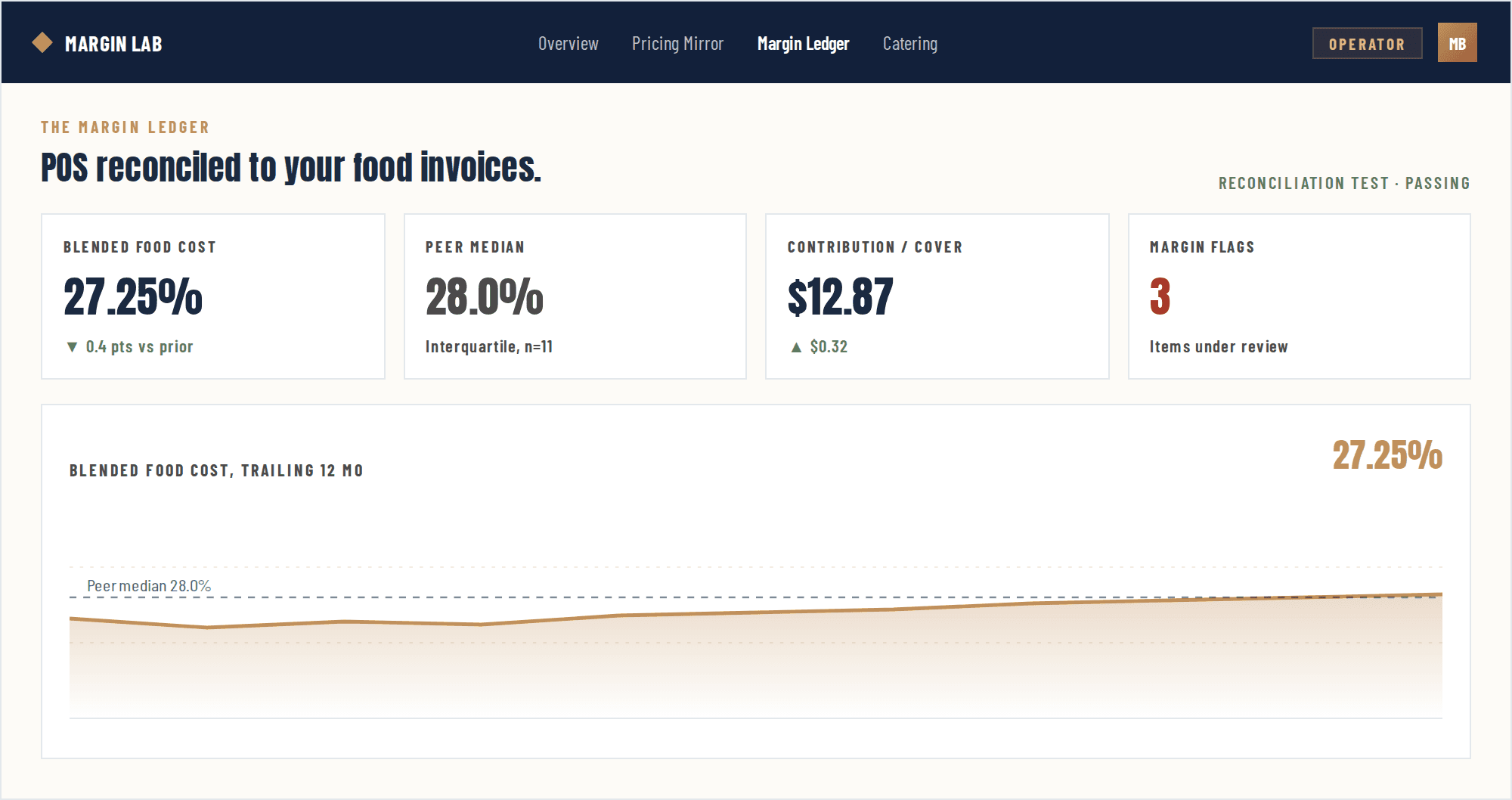
Blended food cost, reconciled to invoices before a disputed miscellaneous credit.
11 of 19
Protein-and-format cells sitting inside the peer interquartile range. The pricing defect was concentrated, not everywhere.
8 of 12
AI answer engines citing this operator by category. Losing questions were specific: gluten-free, kids pricing, ribs.
720
Monthly branded menu searches. The near-term conversion issue was missing prices on the site, not visibility.
16.81%
Grubhub markup measured on matched pairs. Uber Eats and DoorDash exactly 20%.

The Diagnostic reframed the sale from “you're broadly mispriced” to “you have a specific pricing ladder defect and a menu-transparency gap.” The operator declined the broader visibility program the read did not support and signed the Optimization tier instead, on the specific work the evidence justified.
02

Multi-unit family diner, four locations

A reconciled sales baseline that replaced two years of estimated chain sizing.

$26.33M
Net sales verified across four stores, two years, matched to the cent on the reconciliation test.
$18.24
Chain net sales per guest. Defensible baseline against which every opportunity is measured.
$1.02
Per-guest opportunity from internal convergence plus discount-control variance, before pricing harmonization.
1,040
Distinct POS items dispositioned. Every one classified keep, review, cut, merge, or reprice.
643
Competitor prices collected across the peer set to support the item-level moves.

The Diagnostic replaced a spreadsheet of estimated chain figures with reconciled reality, and produced a chain program that runs at both store level and enterprise level. The current work is menu reduction, price harmonization, and the catering engine, in that order. Every engine is capacity-capped, not additive.

03

Growing chain, ten locations, mixed POS

A read that told the ownership group when the answer was hiring, not buying.

3
POS platforms in use across ten locations. Reconciliation was gated until three exports agreed.
5
Opportunity engines sized and ranged. Two engines could not be sized without more data and were declared open, not zero.
22
Pages of appendix documenting every source, every export, and every unresolved gate. Handed to the group's operating partner.
2
Locations flagged for a first repricing wave. The other eight held until POS reconciliation was consistent.

The Wedge Proof did what it exists to do. The group's stronger locations were already outperforming the peer band. The read supported hiring an analyst instead of expanding Optimization across every unit. Margin Watch continued on the two flagged locations. The rest is on hold, on purpose.

The Margin Ledger screen: blended food cost reconciled to invoices with the reconciliation test passing

The honesty gate

Every claim on this site passed a rule.

If a number cannot be traced to a source or explicitly labeled as an assumption, it does not appear. If a peer range does not have five restaurants in the cell, we do not run the comparison. If the Wedge Proof stage finds a client is already winning, we say so and we do not sell them the program the read cannot support. If a Diagnostic finds nothing worth acting on, the client hears that in the delivery meeting. About one in five reads produces that outcome, and we count it as a win.

What we do not do

The rules that produce these reads.

0

Named competitors. Ever. In any client-facing document.

5

Minimum peers in any pricing cell before we run the comparison.

0

Estimated numbers presented as facts. Every figure is reconciled or labeled as an assumption.

1 in 5

Diagnostic reads that end with a recommendation not to buy anything further. That is by design.

Four people talking over notes at a table in a warm brick room

What clients did with the read

The Diagnostic is a decision, not a deck.

Every Diagnostic ends with a written recommendation. The three cases above each ended differently: a smaller-than-hoped Optimization scope, a full chain program, and a recommendation to hire in-house rather than expand our engagement. All three are legitimate outcomes of the same read. Clients get the read they need, not the one that maximizes our next invoice.

The next step

See whether your read comes out like one of these.

Twenty minutes on the phone, four questions about your restaurant, one honest answer. If the shape of your business does not match a Diagnostic, we say so before either of us has spent more time on it.