
The roadmap
What we deliver today. What we are building.
Margin Lab is a service today and a platform in build. Ignite XDS's team delivers every Diagnostic manually, working from your POS exports and food invoices. The seven items below are what turn the manual delivery into a continuously-live platform. No dates. Sequence, sourcing, and honest scope.
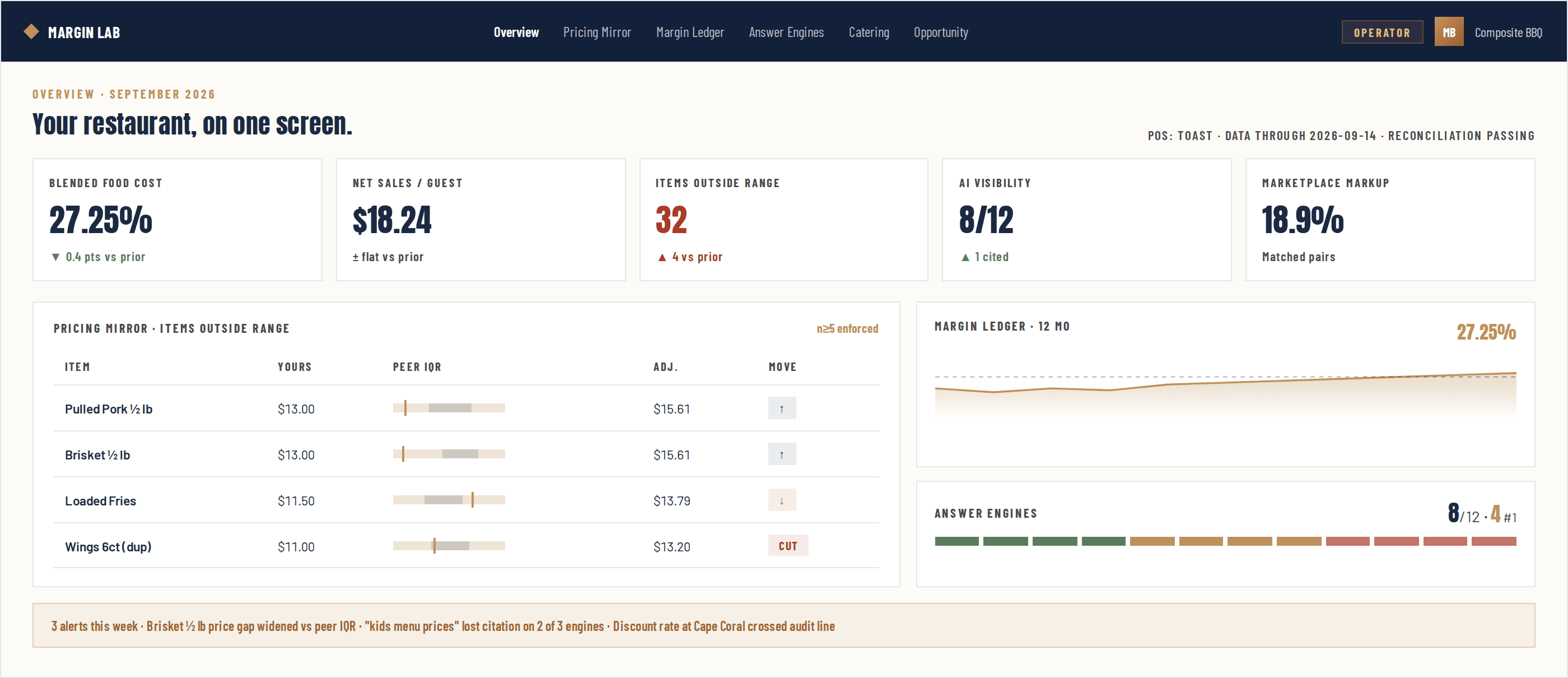
What is live today
The service, delivered by our team.
Every current Diagnostic ships with the same six evidence cards, the two-page executive brief, the twenty-two-page appendix, and ninety days of read-only dashboard access. Reconciliation is run by Ignite XDS. Peer comparisons are anonymized. Answer-engine visibility is scored on the twelve queries that matter for your category. The dashboards on this site are drawn from real client work, running against manually-reconciled data. As the platform ships, the same screens run continuously against your live sources.
The seven items
What we are building.
Ordered by dependency, not by calendar. Each item is real engineering work, in flight or planned. Where an item depends on a partner (POS provider, distributor, data source), we say so plainly. Nothing on this page is a promise about a specific date. Everything on this page is a commitment about a specific direction.
Item 01
Direct POS integrations
Toast, Aloha, Square, Clover, and SpotOn: the five POS platforms that cover the operators we serve. Once the integration lands for your POS, your product mix and sales data flow into Margin Lab continuously. The reconciliation gate you see run today by our team runs itself. First integrations shipping through 2027, sequenced by operator demand.
Item 02
Distributor-agnostic invoice processing
Every restaurant uses three to five distributors. Margin Lab reads all of them. Where a distributor supports an electronic invoice feed, the invoice processes instantly at near-perfect accuracy. Where they do not, the invoice is OCR-processed and matched to your recipe ingredients. One reconciled food cost across every distributor you use. Shipping through 2027, distributor by distributor.
Item 03
Anonymized peer benchmarking network
The moat. Every operator who runs a Diagnostic contributes anonymized pricing, food cost, and catering transparency data to the peer network. Minimum five-restaurant cell enforcement stays in place at the data layer, not just the UI. As the network grows, the peer ranges get tighter, the segments get more granular, and the read gets better for every operator in the system. Live seeding is already underway with current clients.
Item 04
Public AI-visibility check
A self-service tool at https://marginlab.ignitexds.com that lets any restaurant owner see, in ninety seconds, how they are cited on ChatGPT, Perplexity, Google AI Overviews, and Claude for the twelve queries that matter for their category. No charge. No signup. It becomes the shortest path from “curious about Margin Lab” to a real Diagnostic conversation. In active build.
Item 05
Marketplace pricing normalization
Grubhub, Uber Eats, DoorDash, and Google Food menu pages pulled and normalized against your menu, refreshed regularly. Drift alerts when your marketplace prices diverge from your peer range. Sourcing this through a licensed data partner rather than direct scraping, so the pipeline is durable and terms-of-service safe.
Item 06
Mobile Margin Watch
The dashboards on this site are desktop-first for a reason: the Diagnostic is a decision, not a phone task. Once the live platform is in place, the Margin Watch experience needs a mobile app for daily use. Push alerts for pricing drift, food cost variance, marketplace changes, and AI-visibility losses. Behind items 01 and 02 in sequence, but planned.
Item 07
Structured-data publication back to your surfaces
Every Diagnostic identifies structured data your website should publish so guests and answer engines can find you: menu prices, hours, catering policies, FAQs. Today we recommend it and hand it to your web team. In the platform version, Margin Lab publishes it directly to your CMS through supported connectors, including Sanity, Contentful, Webflow, and WordPress. Sanity is first because that is where our own client base already lives.
What compounds
The parts of the platform that get better with every operator.
Peer network
Every new Diagnostic contributes anonymized data. Every existing account's peer ranges tighten as it grows.
Query library
Every category we read teaches us the twelve queries that matter for that category. That library becomes an asset every future operator inherits.
Distributor coverage
Every distributor we onboard extends the tool to more operators, and every operator we sign votes for their distributors.
POS coverage
Every POS integration retires manual export work for the whole book of business at once.
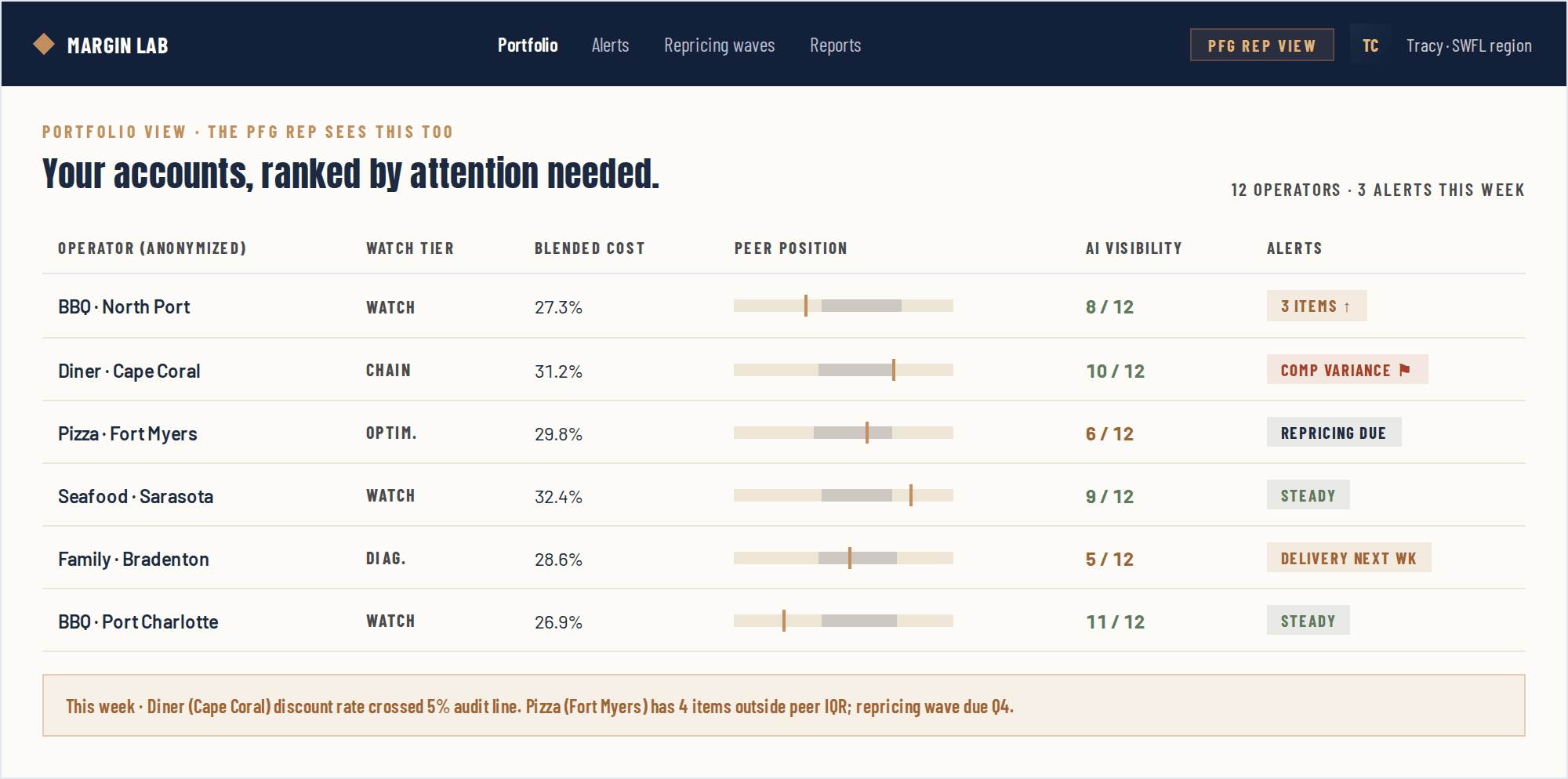
How today's work feeds tomorrow's platform
Every Diagnostic makes the next one sharper.
The reconciliation, the peer-cell composition, the query scoring rubric, and the marketplace-markup coefficients that a Diagnostic produces today are the same models the platform will run continuously in 2027. Nothing is thrown away. The manual work our team does now is the calibration layer the automated version depends on. Operators who sign a Diagnostic in 2026 do not get retrofitted onto the platform. They are already contributing to it.

What this page is not
A roadmap, not a promise.
We do not commit to specific quarters on this page. We commit to specific direction. Every item above is engineering work already scoped or already in progress. Sequence changes as operator demand, partner availability, and legitimate technical constraint teach us what should ship first. If a client's Diagnostic depends on an item that has not yet shipped, we say so before you sign, and we run the piece manually until it lands. That is the whole rule.
The next step
Start with the service. Grow into the platform.
The fastest way to see whether Margin Lab reads your restaurant is a twenty-minute call. If a Diagnostic is right for you, the read runs in the next two weeks with our team. If your POS is on the shortlist for the first integrations shipping through 2027, we tell you where it sits.